
How to Pattern a Specific Buck
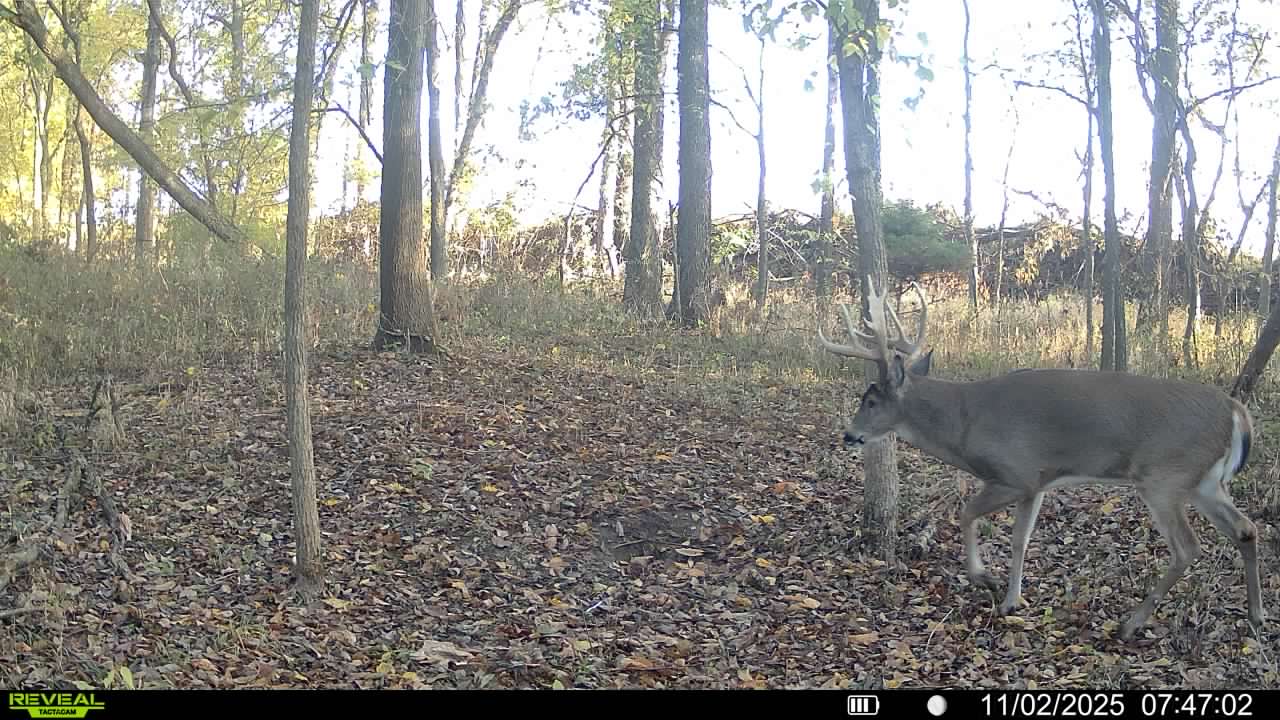
Most hunters who say they have a buck patterned mean they know roughly where he lives. That is a start, and it is not a pattern. A pattern is a repeatable answer to a much harder question: under what conditions does this particular deer move in daylight?
The difference matters because you cannot hunt a location, you can only hunt a location on a day. Knowing he uses the north ridge is worth very little if you sit that ridge nine times and he walks it once. Knowing he uses the north ridge on a northwest wind with falling pressure in the last hour of light is a plan.
Here is how to build that, and how to know when you actually have it.
A Pattern Is a Condition, Not a Place
Every sighting you have of a specific deer carries two pieces of information. There is the obvious one, where and when he showed up. There is the one almost everybody throws away, which is what the weather was doing when he did it.
The second piece is where the pattern lives. Locations shift with food, pressure, and the rut. Conditions do not. A buck that gets on his feet early when the barometer is falling will do that in October and he will do it again in December, even if the field he walks to changes twice in between.
So the unit of work is not "where is he." It is a list that looks like this:
- Wind direction at the time of the sighting
- Barometric trend over the previous 12 hours, rising, falling, or steady
- Temperature relative to normal for that date
- Time of day, in relation to sunrise and sunset rather than the clock
- Sky conditions and moon phase
- The date, so you can separate pre-rut behavior from late season behavior
Six fields. If you capture those every time you get him on camera or lay eyes on him, you are building something. If you capture the photo alone, you are building a scrapbook.
Three Sightings Is the Floor
The most common mistake in buck patterning is drawing a line through two dots. You get him on camera twice, both times on a north wind, and you decide he is a north wind deer. He is not. He is a deer you have two photos of.
Three sightings is the realistic floor for a first read, and even three is thin. At five or six you can start to trust the shape of it. Below three, the honest answer is that you do not know yet, and acting like you do costs you the stand you burn proving it.
This is worth sitting with, because the temptation runs the other way. The rarer the deer, the more weight we put on each individual encounter. A hunter with forty photos of a two year old will happily say the data is thin, then build an entire season around three photos of a giant.
Compare Him to the Ground, Not to Nothing
Here is the part that separates a real pattern from a coincidence, and it is the step nearly everyone skips.
Say you have six sightings of a buck, and four of them came on a northwest wind. That sounds like a northwest wind deer. Now go check how often the wind blows northwest at that property in October. If the answer is sixty percent of the time, then four of six is not a preference. It is roughly what you would expect from a deer with no wind preference at all.
Now suppose northwest only blows twenty percent of the time and four of six sightings came on it. That is a signal worth planning around.
The rule: a condition only means something if it beats what that ground normally delivers. Without the baseline you will find patterns in noise every time, because the most common conditions will always dominate your sighting list.
This also explains why so many hunters conclude that mature bucks love the last hour of light. They do move then. But that is also when most of us are sitting, and when most cameras see the most traffic. Compare his hours to the property's hours before you call it his preference.
What Repeats and What Does Not
After enough seasons of logging, a few things sort themselves out.
Repeats reliably:
- Wind direction. The most consistent individual preference you will find, especially for a buck that has survived a few seasons and uses wind to check a specific approach.
- Pressure trend. Falling pressure ahead of a front moves deer, and some individuals respond much harder than others.
- Temperature departure. How far below normal the day is running, not the raw number. See our cold front guide for how to read the size of a drop.
- Time relative to legal light. Some bucks are consistently last light, some are consistently first light, and the difference is stable enough to plan around.
Repeats poorly:
- Moon phase. We looked hard at this one in our own data and could not find a relationship that held up. Our solunar theory post covers what we found.
- Exact clock time. Movement tracks light, not the hour, so a 6:15 pattern in October is a 5:20 pattern in November.
- Specific dates. "He always shows up November 5" is usually a rut phase effect, not a calendar effect.
Do Not Burn Him Out Collecting the Data
The cruel part of patterning a specific deer is that the act of gathering information is the thing most likely to destroy it. Every camera check, every entry, every sit leaves scent and disturbance, and mature bucks respond to accumulated pressure by going nocturnal or leaving.
A few habits that keep the cost down:
- Run cameras on cell or on long intervals. If you have to walk in to pull cards, do it at midday, in the rain, on a schedule, not whenever you feel like it. Our trail camera strategy guide goes deeper on this.
- Do not hunt him below three sightings. Sitting a stand on a guess is how you teach him about that stand.
- Save the best access for the best conditions. If you have one clean entry that works on a northwest wind, do not spend it on a mediocre day just because you had the afternoon free.
- Log the sits where you saw nothing. A pattern built only from sightings is missing half the evidence. The blanks are what tell you which conditions do not produce.
That last one is the habit almost nobody keeps, and it is the difference between a hunch and a record. Our post on keeping a hunting journal makes the broader case.
How STAT Outdoors Handles This
Doing all of the above by hand means keeping a spreadsheet of every sighting, pulling historical weather for each date and time, and computing base rates for your property. Nobody does that for long. STAT Outdoors does it as a side effect of logging:
- Every sighting carries its weather. Trail camera sightings and in person sightings both capture the full conditions automatically from date, time, and GPS, so the six fields above are never the thing you forgot.
- The trophy file (PRO). Open any trophy and STAT reads back the conditions he actually shows up in, assembled from every sighting you have logged of that animal. The wind he moves on, the pressure trend, the hours, the sky.
- Every line states its sample. You see "4 of 6 sightings, 2.4 times the usual for this ground," so you always know how thin the read is and how it compares to the baseline.
- Conditions that do not beat the baseline are excluded. If a week of steady pressure produced three sightings, that is not reported as a preference. If nothing stands out, the file says so instead of inventing something.
- Forecast matching. Once his pattern is armed, STAT watches the forecast and names the next day that matches it.
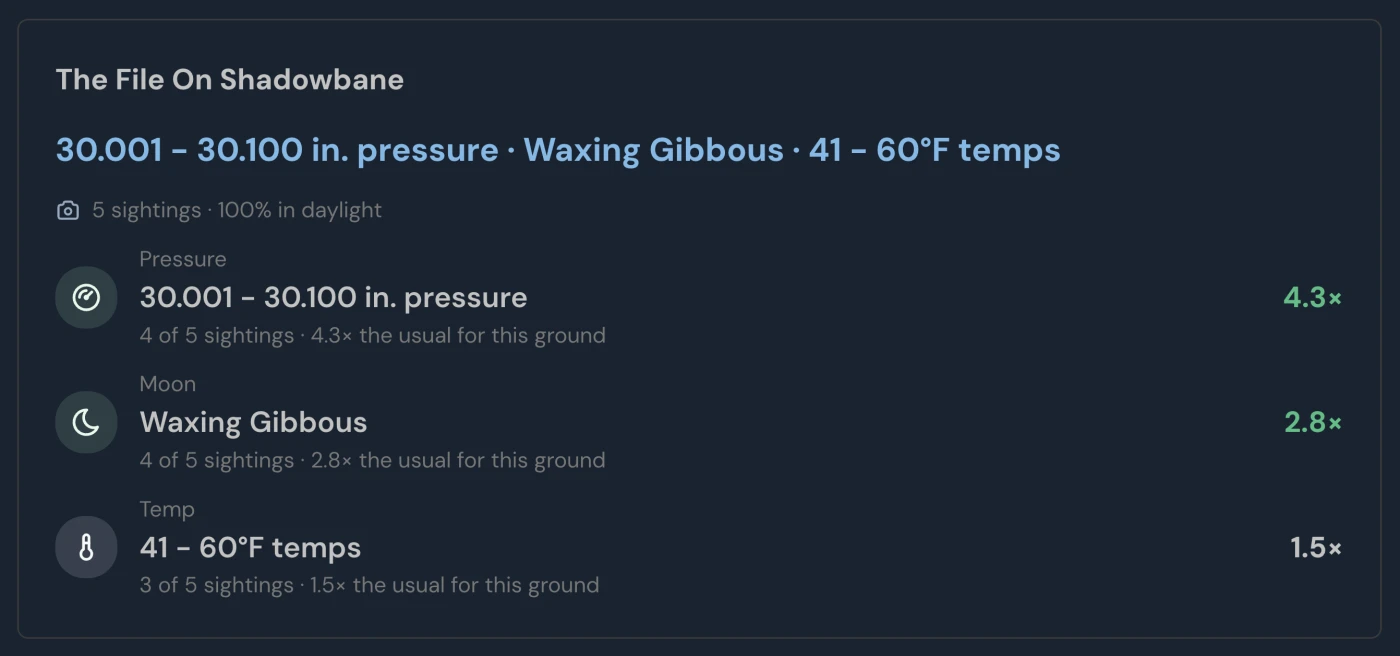
A file built from five sightings. Every line names its sample and what it is measured against, so you can see how thin the read is.
The file opens at three sightings, which is the same floor described above, for the same reason.
Practical Takeaways
- Record conditions, not just photos. A sighting without weather attached cannot become a pattern.
- Three sightings minimum before you act. Two dots is a line only in hindsight.
- Always compare against the property baseline. A condition that is common everywhere is not his preference.
- Weight wind, pressure trend, and temperature departure. Discount moon phase and clock time.
- Protect the access more than the information. The perfect read on a burned out deer is worth nothing.
Patterning a specific buck is a data problem wearing camouflage. The hunters who kill mature deer year after year are not seeing something you cannot see. They are remembering more of what they saw, and they are honest with themselves about how much of it is real.
Start building the file on yours with STAT Outdoors.
Sources
- Diefenbach, D. (2023). Cold Wet Winds of Change: The Verdict. Penn State Deer-Forest Study.